

Britain’s housing market needs major surgery, and we are busy sticking plasters.
Housing again took centre stage this week, with more policy promises from house-building targets being bought back in by the labour party and re-introducing the help-to-buy scheme by the Conservatives. Critics of the help-to-buy scheme have suggested that it will drive up house prices and said that it fails to tackle the underlying issues of the housing crisis. On the other hand, Labour promised to re-introduce the target of building 300,000 homes a year in England, which was scrapped last year by the conservatives.
Experts agree that 300,000 new homes a year will start to make inroads in housing affordability. The conservatives argue that the previous labour government built the lowest number of houses since 1920.
The graph below highlights the average number of houses built each year. Under the last labour government, 176,365 homes were built on average annually, and the Conservatives, since they came into power, have delivered 188,572 a year on average. Successive governments have failed to meet the house-building targets. Freddie Poser, director of the affordable housing campaign Priced Out, warned that “Help to Buy is a sticking plaster on a completely broken housing market” he warned that bringing back Help to Buy would not tackle the shortage of new homes.
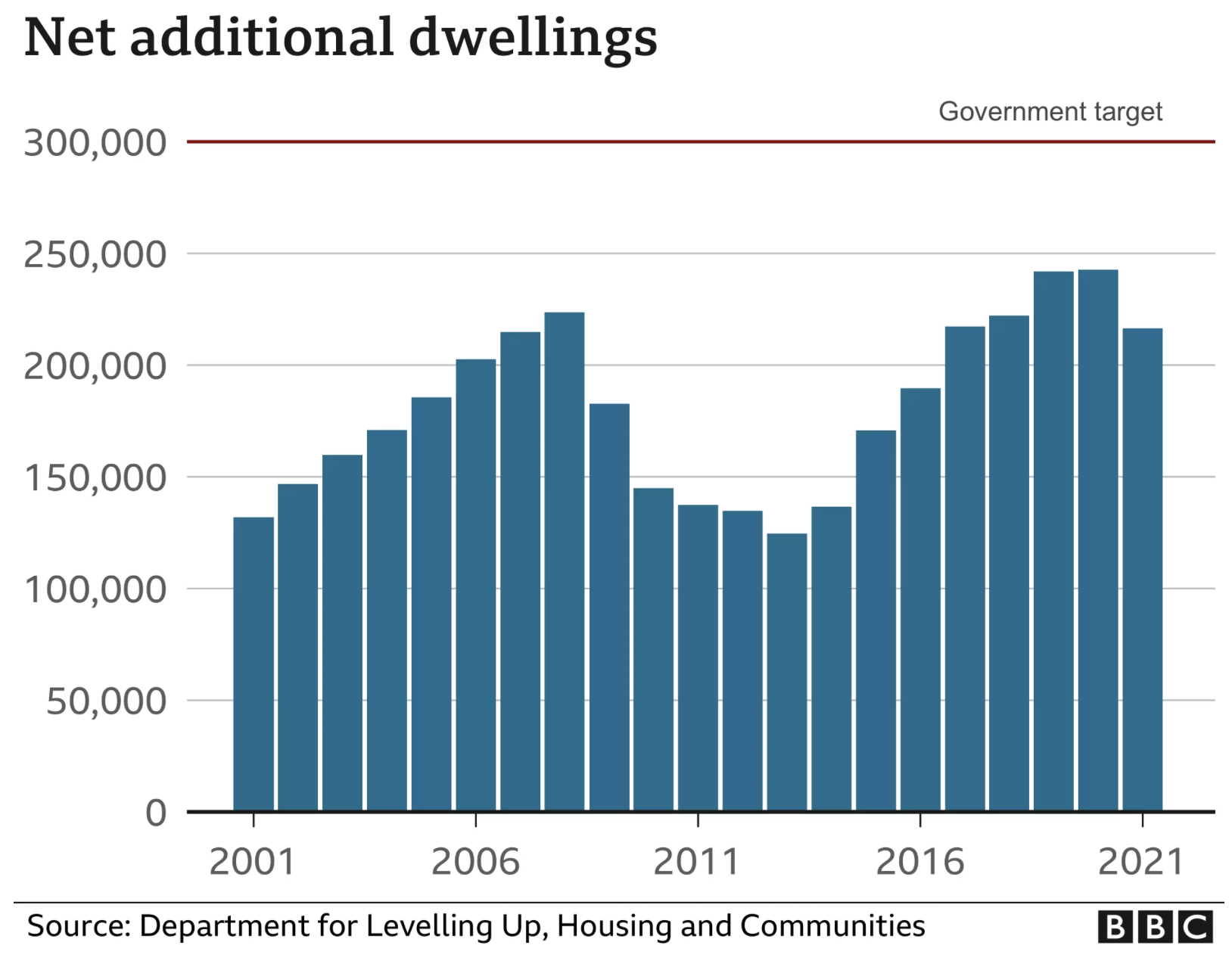
Andrew Wishart, a senior economist at Capital Economics, says construction volume increased by 10 to 15 per cent after introducing the help-to-buy scheme, which added 15,000 homes annually. So, while it probably did raise the new-build premium, wider house builder margins translated into more supply. The increase in house-building activity since Help to Buy was introduced in 2013 is highlighted in the chart above.
An opinion poll this week by Survation highlighted how important housing is to voters; it was the fourth most important issue on voters’ minds after cost of living, health and economy.
The government needs a long-term strategy to reform the housing market. We look at issues currently facing the housing market and how they can be addressed.
Build more homes, but labour is in short supply:
Address labour shortages:
The biggest issue impacting the supply of homes is the shortage of labour. The government will not admit this as it directly results from Brexit. A mass exodus of EU workers after Brexit has led to a chronic shortage of construction workers. There are currently 45,000 builder vacancies in the UK today. At this rate, industry experts predict that 266,000 more workers will be needed by 2026. The Home Builders Federation (HBF) predicts fewer than 120,000 properties will be built this year compared with a government target of 300,000.
The government has added the sector to the UK’s “shortage occupation list”, which loosens the rules for overseas construction workers. However, according to HBF, they need to do more, including improving poorly targeted college courses from which only 25 per cent of graduates take apprenticeships.
So, the political parties can have all the targets they want, but if there are no construction workers to build them, the targets are meaningless.
Reform Planning Laws:
Breaking the planning logjam is essential. Councils must be forced to adopt mandatory local plans that guarantee a certain amount of affordable and first-time buyer housing stock and crucially be made to stick to them so that developers are encouraged to submit applications with the likelihood that they’ll get approved.
Help downsizers:
Potential downsizers frequently have nowhere to go because of a supply shortage, leaving many older people in large properties they would rather sell and clogging up the housing stock. Chris Sykes, technical director at Private Finance, says that a stamp duty discount scheme for downsizers is vital. “There is plenty of good quality housing stock out there that is being sat on by older homeowners”.
Boost factory-built homes:
Boosting factory-built homes will also go a long way in meeting the government’s target of net zero by 2050. This will also, in some way, help address the shortage of builders and focus on modular construction or homes built in a factory. These houses, also known as pre-fabricated modular homes, are not only 30 to 50 per cent faster to build but also greener.
The government should look at incentivising this sort of building practice by offering tax breaks to developers, and modular homes should be given planning priority. Currently, only about 15,000 new homes per year are modular.
Boost mortgage availability
One of the big problems Help to Buy was designed to solve, and it did so successfully, was that many first-time buyers needed help raising mortgage deposits. According to Ryan Shorthouse, chief executive of Bright Blue, a centre-right think tank, getting a mortgage has become increasingly difficult for first-time buyers. High-interest rates and three years of high house price growth have become an entry barrier for many first-time buyers.
The government is considering extending the 95 per cent mortgage guarantee scheme due to end this year. Labour is also working with lenders to develop a mortgage product that helps first-time buyers get onto the property ladder without requiring a deposit. How this will work is yet to be seen, but rent payment history is touted as a significant factor in affordability assessment for these types of mortgages.
Paula Higgins, chief executive of the HomeOwners’ Alliance, which represents homeowners, says the gap between earnings and house prices has been widening. We have been missing housing targets for the last 30 years. The government’s strategy in some areas is to make high-level announcements and promises, raise expectations and then not deliver. The government needs to start thinking long-term and deliver a housing policy that will have a long-term impact or risk making homeownership for first-time buyers a distant reality.